

The devil in “Beat the Devil” (2002) by Tony Scott resides (or he has his living quarter crossing at this world) in Crossroads. See below, the image I did screenshot from the video, Beat the Devil, from YouTube.
Subsequent images are also my screenshots from the same source, YouTube. Merilyn Manson, played as and by himself, makes his cameo appearance in the end to convince viewers that the Crossroads is really what it says.
**

James Brown and his hired driver arrives at Crossroads for a new deal with Devil.
**
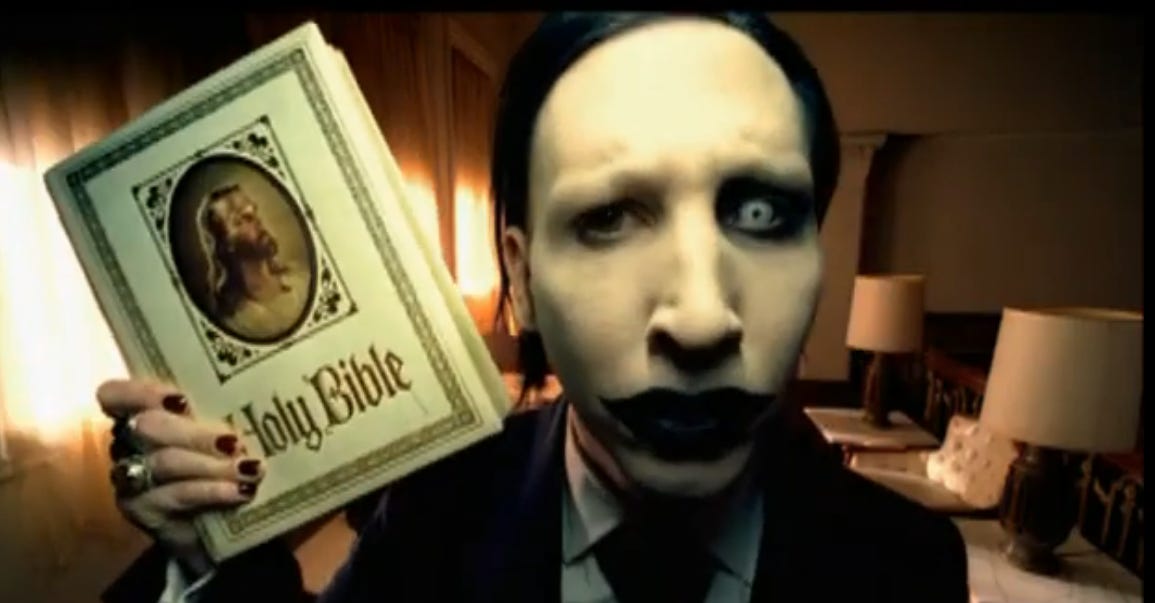
Merilyn came at the door of Devil’s chamber to complain about the Devil’s noise which disrupts his reading. According to Devil, Merilyn is a paranoiac freak living downstairs, who spooks out Devil. “He’s weird!”
**
“Complaining about the noise?” says Devil.
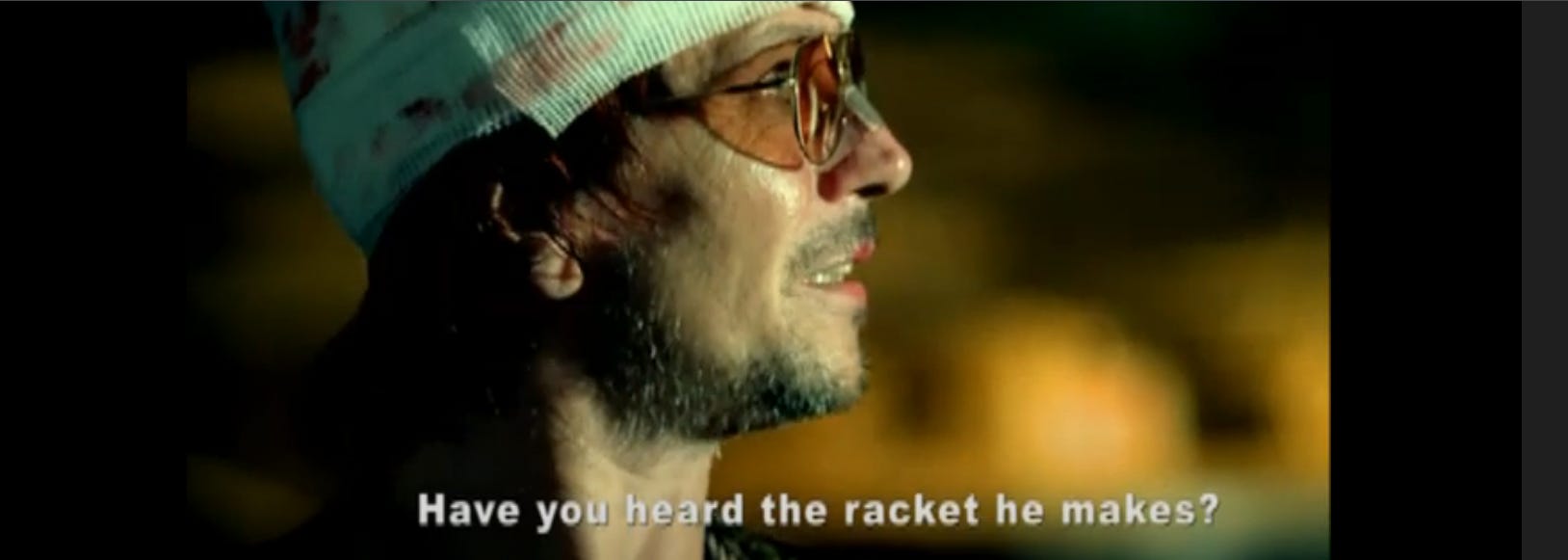
The credit score in the end of Beat the Devil is the actual racket.
Below is one I picked from Soundcloud. A live version.
Merilyn Manson, “Rock id Dead”:
Read or re-read also my immediately relevant publication, Beat up Devil !
****
In the end of Interview with the Vampire (1994), Sympathy for the Devil (Rolling Stones), is sung by Guns N’ Roses.
The original Stones from Soundcloud:
Read or re-read also my directly relevant publication, Guess my name !
**
In fact, my publication of today, yes, this one which you’re reading, is still about Bugonia (2025) on which I committed myself yesterday, Beat up Devil. Very early this morning, I finished my rewatch of it online. That’s my second viewing of the movie and it was very worthy.
FROM HERE, SPOILER ALTER IS HIGHLY EFFECTIVE
****
There are virtues in rewatching a movie, any movie, but especially the rewatch value is high in Bugonia for me. At this time, I focused. Which means, most significantly and importantly, I knew what sequences I want to skip, exactly where. Bugonia has a strength of theatrical dialogues with refined and raw or undefinable acting of the cast I described as perfect.
Besides! Notice and know Jesse Plemon’s all moves, literally his all moves, how he is moving, how he’s walking, how his shoulders take rhythm while dragging his bicycle and talking with Don (played by Aidan Delbis), how he rushes over the table at the CEO (or the alien played by Emma Stone) Watch how he blinks his eyes, how he shows his perplexity. Pay attention to how he makes the discourses of his plan, elaborated via social media and online research for imminent danger at Earth and all livings, developed further into and from the traumatic family drama vs the superpower of corporation. The movie, however, blow up Teddy (or Plemon’s acting for the mostly quiet and sublime insanity) in the end in the closet (or transportation immobile pod) in the CEO’s office. Yet, Plemon is the vital force in Bugonia. He won.
Emma Stone is gorgeously talented, no one can deny that. So, I don’t have to say much of her here. In my second viewing, I found Don is the key figure, which I didn’t see in my first watching. Andromedans who finally appear in the end are figuratively very similar to Don, or vice versa. Don could be understood as a symbolic alien or a non-symbolical alien or an authentic alien from the beginning. But no one knew, possibly not even by the production side except as a vague implication as an unsaid inspiration shared mysteriously by cast and crew. When I remarked this, I felt a bit easy on his shocking suicide, (which I naturally skipped to view during my rewatch act).
As all signs indicate, Don must have known that’s the only way for him to transport himself to the space most immediately. Then, my feels of temporary relief from pain quickly faded and disappeared. This movie is too cruel and dark. Many viewers, with no doubt, see Don as the most empathic and sympathy worthy character in Bugonia. In my view, Don therefore shouldn’t have to be brutalized, though importantly, though film-wise strategically, for the sake of the biggest impact and shock value. Then, what? His image revives implicitly in the end by the figurative resemblance between Don and Andromedans. This movie is cruel and dark. Nevertheless, Don won. But how? I can’t tell. That’s how he won.
Certain people see everything and any thing psychologically and pathologically for making their point of cleverness to show off their intellectual depth as self-imposed. A movie like Bugonia is their easiest prey. Because so many things are psychopathic, more weird than the freak living downstairs and making the racket.
Such people point their fingers at me to say a psycho is attracted to a psycho film, or some such things. Certain people are impossible to view a movie, any movie as a movie. Thus, a movie won. Because however much it’s bad, cruel, or brutal, or dark, a movie is a movie. That’s it. Not as a therapeutical material.
**
My rewatch of Bugonia made me think of Pan’s Labyrinth (2006) by Guillermo del Toro. There is a threshold to enter the realm of other world. Most conventionally, the pass-way is depicted as gained when one quits this world. It’s true for Ofelia (Pan’s Labyrinth), it may be true for Michelle (CEO in Bugonia). It could be true for Don too.
Images below are my screenshots from YouTube.
**
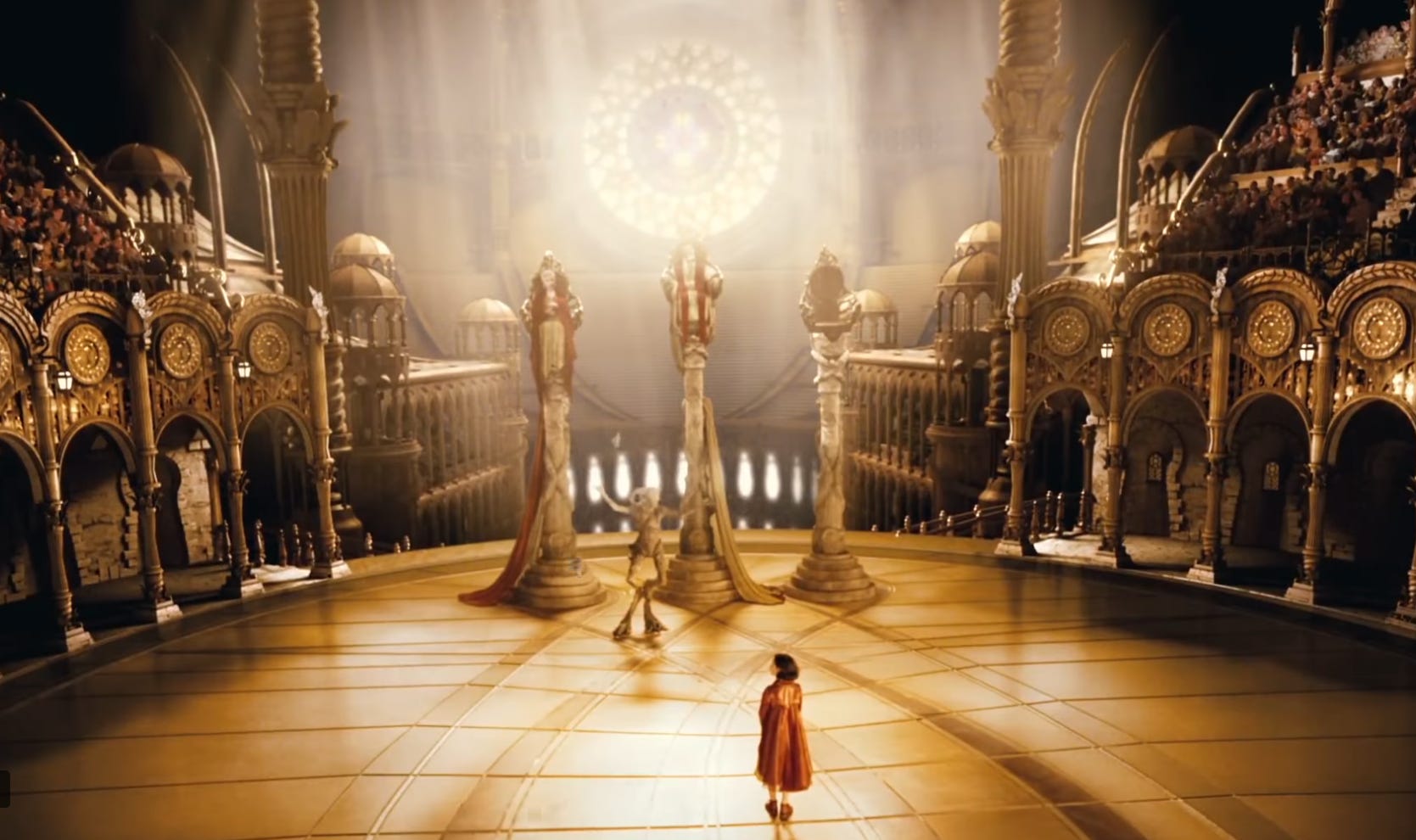
In the end of Pan’s Labyrinth, she returns to the Kingdom as a princess. Her parents greet her.
**
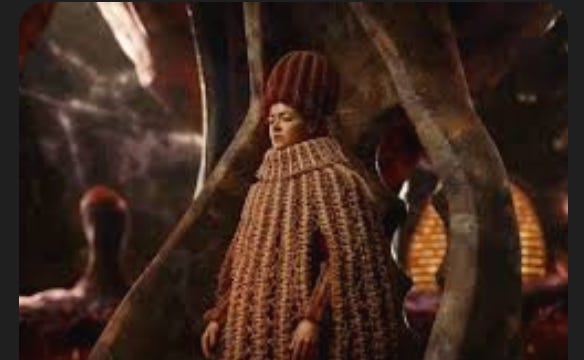
In the end of Bugonia, she returns to the mothership where her peers greet her. That she concluded there the experimental operation on humanity would have been cut completely is my dogmatic opinion. That ultra weird phonetics of the conversation by aliens in undefinable but seems to be mixture of Russian, Eastern European, a bit of Romance languages, plus some aboriginal phonetics from wherever, who knows, (if one seeks earthly linguistic references, I mean), is sufficient enough for me to conclude the movie.
****
In Beat the Devil, James Brown got a new deal. In Interview with the Vampire, the other vampire who never has with no remorse nor suffering enters his new realm as a devil. Beat it while rolling. Ephemeral and delusional entres to such a realm are there in movies. In Bugonia, Jesse Plemons built such beat with no Rock n Roll.
******
Realm crossover by Juliette Masch (1/30)