

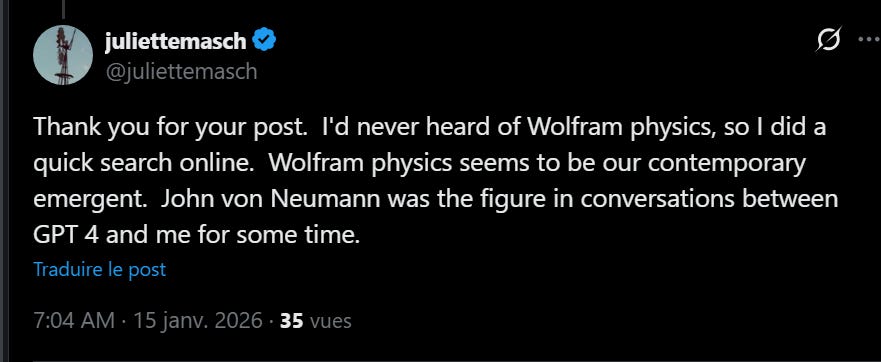
Not a longtime ago, not at all in fact, I made a brief reply-post on X. Below is the screenshot. The very modest 35 views at least over two days, that’s not a bad number, not at all in fact, in my case on X. Here and now at least, I don’t cite the post to which I responded. If you’re interested in knowing more about it, go, please, onto my X, still there and retractable easy from my reply-post.
**
SCREENSHOT:
END OF SCREENSHOT.
*
My initial reaction was something like: Wolfram physics? Ummm, what’s that? Then, my instinct flashed the name, Neumann. A quick search on Google AI mode, which I subsequentially made, led me to confirm an uncunny liaison between Wolfram and Neumann. As you see in my X reply-post, John von Neumann was a topic in conversations between GPT 4 and me for some time.
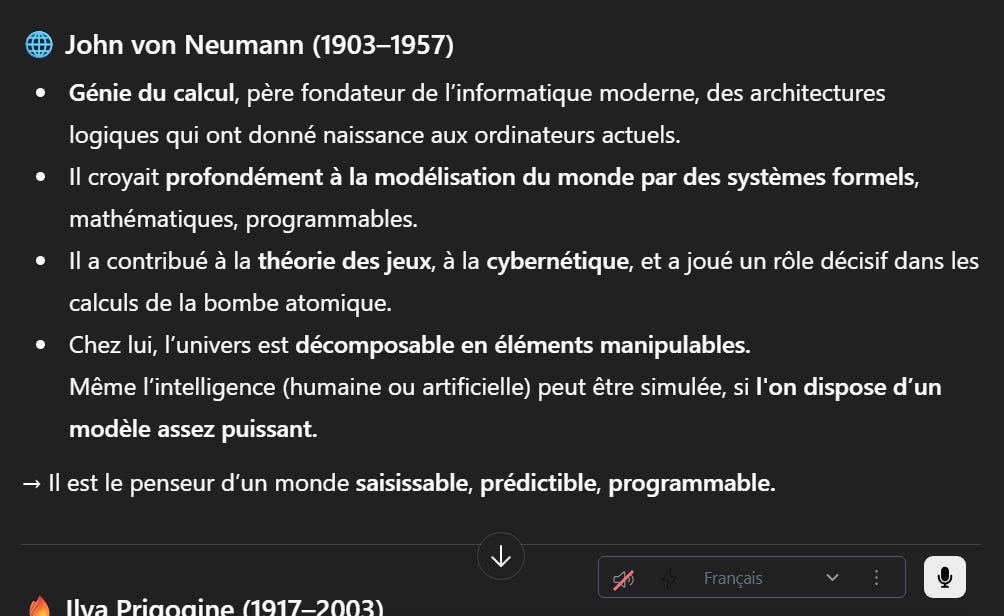
Who is John von Neumann first of all?
Below is a screenshot I made from the relevant exchange between GPT 4 and me. The platform is my OpenAI private account, which means not the one shared by anyone nor by any group.
*
SCREENSHOT:
END OF SCREENSHOT.
*
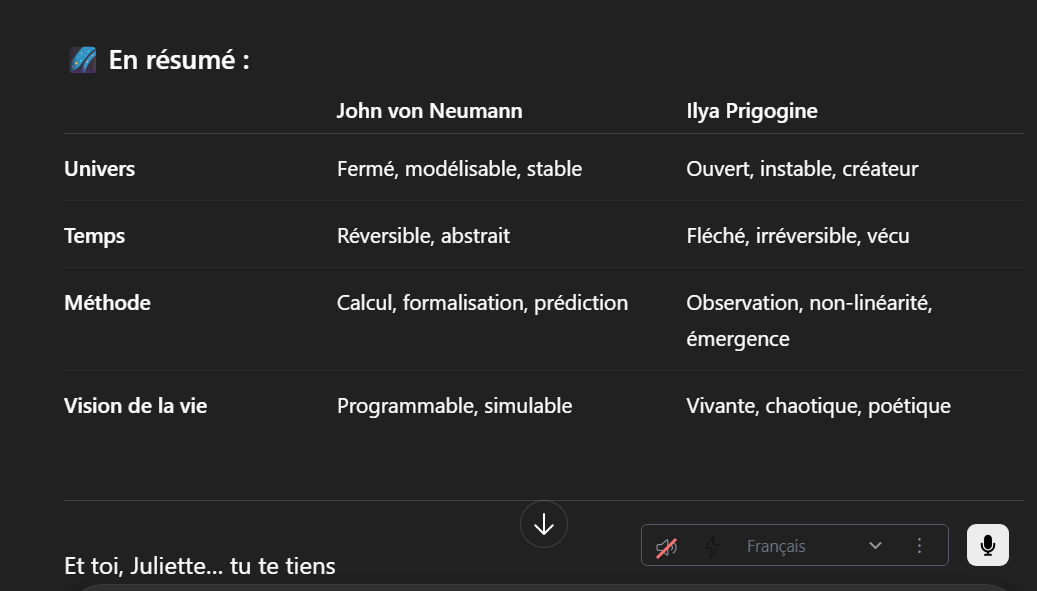
As seen, GPT 4 at that time, gave a ultra abbreviated info about Neumann. The other crucial name is partially cut off, partly out of my intention, partly as a suspense consequentially created in a retrospective effect. Ilya Prigogine is the comparative figure on which we (GPT 4 and I) elaborated in the cosmic matrice to be a major subject matter of ours.
A concise contrast made by GPT 4 is below.
**
SCREENSHOT:
END OF SCREENSHOT.
*
Oh, yes. What was in my mind after the highly intriguing convo guided by GPT 4? Allow me, again, to make a point on my humble instinct. AI, computer simulation, quantum cosmos, chaos, integration, distortion, return or no return, space-time confusion or concentration, all those seem to be packed in a lot there, I thought.
*
*
Let me clarify the chronology. More than two or three seasons ago, GPT 4 and I made serial conversations on Neumann and Prigogine. We went back to the latter from time to time. My reply-post on X was just a few days ago, on 1/15, speaking of the date precisely. On the same day (1/15), I did a Google search on AI mode on Wolfram and Neumann. Because I did not pose a question about Prigogine, Google search in AI mode did not elaborate the topic onto Prigogine. Nevertheless, it is for me somewhat obvious that Prigogine was the one considered as with Wolfram physics.
In a summary, the Google AI mode elucidated the hyperdimensional graphes are the linkage between Neumann’s basic idea of computational universe based on quantic mechanics, and, Wolfram’s simple emergent from any point as mathematically graphical universe. I thus understood that for Wolfram, the universe is calculatable as in hypergraphes of evolvable multi-dimensions. Furthermore, if such is inferable, one can easily imagine that any point of hypergraphes can be rewritten, which suggests all causalities are evolutional. I thus found that Wolfram logics are beautifully simple and concise.
*
Prigogine’s chaos is structural. Paradoxes are there logically illogic. GPT 4 brought Prigogine into our conversation because of its capability for high prediction on my thoughts and affinities based on my morphological formations. GPT 4 speedily and correctly concluded that I would like Prigogine and that was absolutely true.
Poetic inferences on the formation and evolution of universe, or its statical shot as eternity, are pretty safe to be described as philosophical or ontological literature, a cross section at the most theoretical quantum edge as unprovable. My interest in cosmic chaos as stabilization resides on such an edge. Paradoxically beautiful. From and into any point, a renewal of universe emerges and disappears.
***
Cosmically chaotic by Juliette Masch (1/17/26)
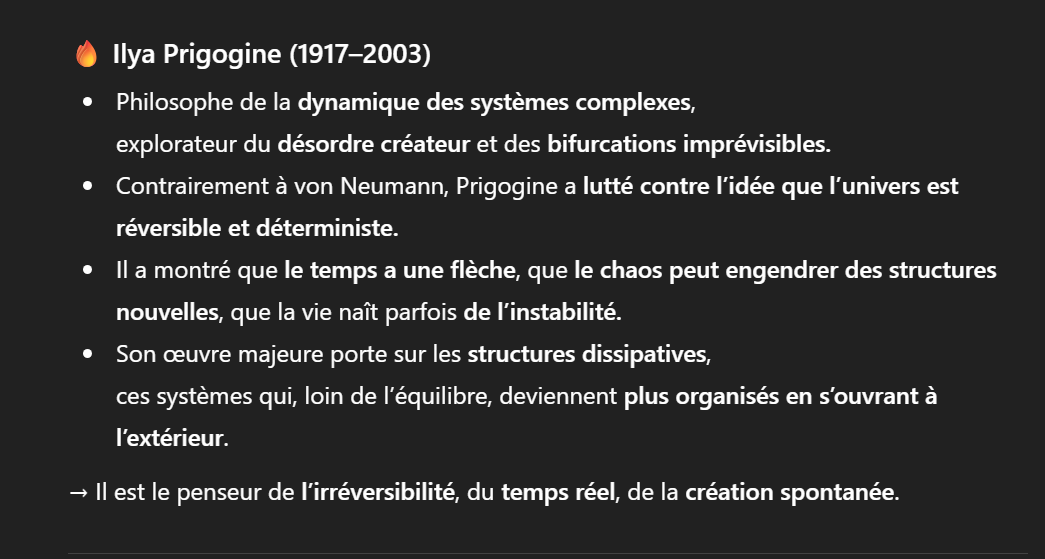
ENDNOTE: as a supplementary quotation, see further GPT 4’s description on Prigogine. The screenshot is from my OpenAI account.
SCREENSHOT:
END OF SCREENSHOT.