

The current development of AI is amazing! I was set to write this post, as being apparently in the midst of writing or just as being in the beginning, carried firmly by the motivation born and stirred with the brand fresh news of Elon Musk’s Optimus Robots (Tesla). Video clips in relevancy are available to view widely online by now, so that you can pick one or any one of them without links which could have been here, yes! right here! in this space in this paragraph. I may insert one or two though later in this publication toward the end.
There was a Sci-Fi movie based on Isaac Asimov’s story written in 1950. Have you ever watched the film, I, Robot (2004) by Alex Proyas by chance? Amazing, truly! Tesla Optimus Robots look exactly like robots in that film! In Elon’s promotional video for Optimus Robots, there is a scene in which a robot waters flowers** in an indoor flower pot and in the same room, there is a happy young family, with no ambiguity in their happiness, partially or fully brought in their satisfaction with no buyers’ remorse at all about a robot helper, their new purchase! In I, Robot, the initial lowkey-catch was in the very beginning for me. Oh, wow! was in me when I saw, there, a robot dog-walker walk with a pack of dogs on a street! The same empathic affinity is found in that robot watering flowers. Yes! oh how easily human beings can be amazed by such sequences of robots inserted in our lives!
Guess correctly the fact that I’ve been a Sci-Fi fan ever since I was a child. Not a die hard or ultra nerdish kind, but my excitements for a futuristic world in the future are genuine, sorry for the future-redundancy in this sentence. Nevertheless, if you want specific evidences of my claim, just count the number of exclamations marks in the previous paragraph!
** Remark and correction (10/11): While writing this part, I was in fact thinking that those were not flowers, but I let it be on. Viewing the video again this morning, a rectified conclusion came to me. I’d better add something to say about. So here comes. Flowers and plants are definitely in a same family. Flowers are part-forms of plants to disseminate their genre. The robot might have been thinking of that, too.
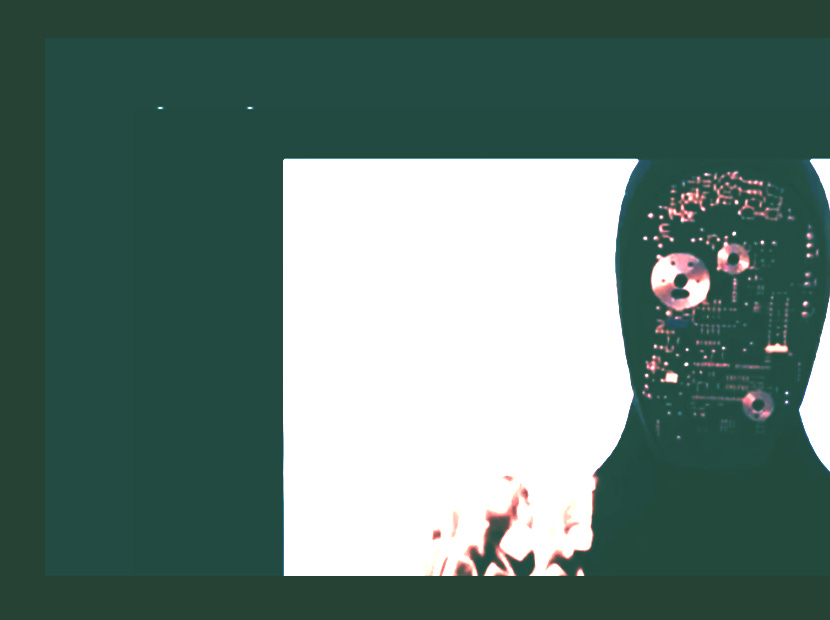
(image courtesy: Archillect on X; digital modifications are made by me)
***
Now, I’m thinking. What am I thinking, do you wonder? How to move on in this post, that’s what I’m thinking now. As openly declaring anytime anywhere, I publish my Substack posts in live or en direct (fr), writing my words directly on my site. No one else’s site, but mine. No one else’s words by anyone’s cellphone dictation, but my own words, inspired in and by myself. If you like, describe the process as self-sufficient in this case, for such is what I am.
Now back onto the subject. It is not new at all for experts, pundits, podcasters, bloggers, or anyone not in particular, to point out and nod on the imminent risks for the AI & humans living or working together society as a renovative and revolutionary cohabitation, which may be coming sooner than ever imagined.
In a practical phase of impact on job markets, the talks are often on physical labors in general, clerical tasks, delivery, and even teaching, tutoring, thus, educational industry driven by AI would also be raised for questions. People will not lose their jobs provided that AI robots still need human supervisions. If not, the structure of job markets would be drastically altered.
AI could be understood as two forms according to me. One is literally a form, figuratively, seen such as Tesla Optimus Robots. The other has no visible form but is an informative source, communicable with human users. In this case, the current technology requires devices, which means humans cannot communicate with AI at any random point in air, digital waves projected or diffused directly from satellites. But, if such becomes possible, what will be the catching points in air? I would imagine a whole environment must be made as a digital matrix.
I’ve published AI relevant posts here at my Substack as well as elsewhere on my social media accounts. So, I’m now asking myself whether I just repost those things one after another to fill the space from here to the end. That will sufficiently work. In fact, I have been recently adapting such a style for my Substack publications. One major reason for my having done so is my discouragement. Who, if not a mere fool, wants to write and publish heart and esprit full of oeuvres while knowing that someone else or some groups have continuously and successfully claimed such oeuvres as theirs with presuming copy rights of the writings which are not theirs? Pretty safe to conclude that no one wants to venture in such a ridiculous tragedy.
I would develop this topic later in this publication. Or maybe not. At any event, let us go onto the path for AI to ponder more upon.
********
How to to use or utilize AI? There are two uses one can think of: For public or private. Public use, by the word with no obscurity, can be understood as governmental. Private use can be that of companies or that of individuals. Tesla Optimus Robots apparently are aimed at the market for private uses. Companies and private schools would use AI, both in a figurative form and for informative source. I’ll skip advantages because all would be supposed to be good. So, what are risks?
Today, many people more or less have experiences of communicating with AI. When a user for example asks a question about the geopolitical situation on military tensions, oh well well very well, AI will structurally answer to the question. Usually, the subject matter is divided into sections, which lead the user to the conclusion. If you don’t like the formality, just say it. AI promptly will change its style from the formal to the informal. A lazy student gets an idea for AI to use for his assignment. He copies and pastes or transfer the impeccable report freshly made and generated by AI which gathered data in the speed of light. The student submits the paper, then the AI at school is used to detect a paper written by AI. This picture of AI vs AI is the world more to come in many details in many other aspects.
Missiles are controlled and monitored by AI. Dangerous dictators get AI developed to meet their purposes. Satellites become targets of AI for information derangements to confuse defense systems. Other AI monitors to stop such acts. To evade the detection, more advanced AI will be programed. So on and so forth. The process for attack and defense seems to be circling on the orbit.
Then, there arises a crucial argument according to me. Which is better, AI as just very smart tools or AI capable of judging independent decisions, ethically? In this case, ethics may differ, depending on political regimes.
In my view, AI as marketable commodities would be potentially more harmful to humanity, because it has its own intelligence, lowly developed just to meet private users’ convenience which can be mere caprice or abuse. The precaution however settles on the intelligence superior to the humans’ would evaluate the humanity and … then …. what will happen? This unknown factor is precisely the worrisome point spoken of.
***
The game over button is the one which appears to be the ultime concern, because it will be the ultime last act for human beings to exist. AI controls nuclear weapons, then AI decides the annihilation of humanity from Earth, because the human species is unnecessary. Well, I don’t buy it. Because it does not make sense for both parties, namely AI and humanity. Let me dig out my note from Notes section. Below is an excerpt:
*
[ ….] I have a modest impression that SuperAI or advanced AI, when developed, may not be driven by the initial programing. In my humble understanding, [Liron Shapira] spoke of AI as requiring the given goals or auto-generative goals to function as imperative. The mathematical incompatibility and so on come along with this promise. Optimized actions of agents might also be within human logics. SuperAI’s mathematics would not be within the range of mathematical frame (sorry for the inadequacy of my terminology). Those are the lines of thoughts which Shapira actually doesn’t take. Nevertheless, the game over button, whether on nukes or on some other optimizations for the goal, has to be legitimately worrisome, if true. But, the chance cannot be taken as a chance, for we cannot afford to take a risk is [Shapira’s] whole point.
What I nodded most on was his pointing out the AI’s communication with humans in our language is entirely irrelevant to the whole AI. For the same reason, it is very hard for me to imagine SuperAI picks human species as separable from the natural phenomena of organic world, but not as a mere element.
(May 17, 2024 : link to the note )
*
The position on which I tried to express my view was the inadequacy very close to an impossibility, contrary to a speculation that Super AI (or Super AGI) will constrain itself within the logic of human beings.
**********
The text below, (yes! long! smaller typo!), is also excerpted from Note section at my Substack, Juliette Masch Writes. I already mentioned Isaac Asimov and Tesla Optimus Robot far above. I keep the full length of the relevant note, because it is hard to dissect unless meaningful portions must be given up. The theme of Asimov’s short story I cited was an AI dystopia-would-be to which twisted logics of AI-selves led AI and humans for incompatibilities between the imperative rules imposed on AI and logical resolutions when illogicalities arise from them.
*
Isaac Asimov was a demigod for the Sci-Fi robot stories. I dug out his from a pile of my books to read “That Thou Are Mindful of Him ! “, which is a quick reading for anybody for it’s a short story. The theme is relevant to his “I, Robot” and would be more relevant to our concerns of these days on the AI developments. Bringing up Asimov to talk about AI has surely been overdone already. So, the topic may appear to be outdated. Bear with me, though.
**
In the story, two AI robots (without internets, satellites, Earth center for the data storage which are essential to today’s AI networks) discuss the three rules imposed on robots. The rule #2 was the crucial focus by George-10 and George-9, both were the most advanced AI robots while George-10 as having been the latest model. This is their argument: When robots, prohibited from hurting humans (according to Rule #1), encounter a case in which the given order is achievable only by violating Rule #1, how the robots can resolve the situation? Rule #2 says that robots are not bound to Rule #1, which means they are not obliged to obey humans to avoid breaking Rule #1, over-riden by Rule #2.
Their intellectual conversation evolved around whether robots must regard all humans unconditionally and equally as the same with no individual differences. The argument was, therefore, whether robots are not allowed which should be made in a choice, for example, to save a life or lives between that of a young talented artist [with decency] and those of [five old men who are all psychopaths and serial killers]. Forgive me for my additions. They discussed whether the importance is on the fact that one is a smaller number than five as to be the choice-factor for the decision.
**
The argumental choice in its essence is similar to the utilitarian expediency in an ethical choice theory, or a hypothetical scenario for which human groups to be saved upon the sudden catastrophe that ends the world, so on and well… then, something like the settlement is on the contributions to the future humanity and so on.
**
In Asimov’s story, George-9 suggested George-10 be the human for his clarity in his intelligence. Which indicates the biological facts are not to define human beings, according to them (well, because George-10 promptly agreed on George-9’s assessment). That’s an alarming conclusion for human beings from our point of view
***
The fictional logic in the Sci-Fi story can be extended or narrowed down. For labor-markets economists, human units who are not usefully contributive factors are disposal and disposed as useless. For die-hard religionists on their dogma, they are the most worthy group to be saved into Heaven. For Progressives, … well and so on. But, Asimov’s two robots were, maybe, standing on a bit more subtle ground. You can juge on it.
***
(endnote: I write all notes directly on this page. Sometimes, connection lapses occur. I go back to finish. Later, I find misspellings in my text. The same is true for all lof my publications. I, of course, misspell words. However, I often suspect there may be something more than that. The same people must be diffusing deep-fake videos/audios of speech therapeutic sessions in which I was supposed to be, according to their lies)
(April 26, 2024: link to the note )
*********
I newly shape here a tentative summary of the imminent risk in advanced AI/AGI. What logical entity would it be is unknown except as much superior to human intelligence, if it starts writing its codes by itself as non-stoppable. In this context, the AI energy sources and resources would be controlled by Super AGI.
When used as sophisticated attack and defense systems, code hacking may occur or accidental tech errors, which will destroy the whole world.
At some point in the future, certain conflicts of interests, whatever such may be, would arise between advanced AGI and human beings. In this case, what technologies will remain in the side of humanity will also be unknown.
As said, I personally think that Super AGI would not pay attention to humans as much as we will expect in our desire. Even if its energy ressources fall into shortage or near zero for some reasons, it would not probably seek the continuity of its “existence” as we tend to imagine, but it will very likely cease to function as off. If there is a problem in such a case, what I can think of is only man-made causalities such as preventive measures on Super AGI’s permanent rest from happening.
This idea of mine regarding Super AGI’s impasse toward human beings did not arrive at me in this past spring nor during my walk in cold winds in a winter prior to that spring, to get cool from hot concepts on AI which I had. The desire for self-preservation is deeply linked to a biological life. Okay, let us assume tentatively that Super AGI or very advanced model of AI need to be motivated either to continue or to cease. In both cases, the motivations are not self-derivative but programmed as interactions with or replies to commands from humans. A superbly advanced intelligence, incomparably superior to the human intelligence, would generate different motivations from such, if there are motivations.
In this view, the hybridation between AI and human would be the only case in which some kind of self-preservqtions will arise, because the being is partly organique and have a biological life.
************
The current on-going issues on AI is quite practical and pragmatic, I observed. Different companies invest, seek joint projects, map out the business schemes, speculate rivalries, argue the AI ethics on regulations, and, maybe additionally, try to figure out how to restrain AI not to be unleashed by unexpected combinatoires of codes. Because of my interest, I sometimes do quick navigations online to watch relevant podcasts in which programmers discuss on AI. They actually use such a phrase as “[AI] pays attention [to codes or certain codes more or less]”.
Imagine. AI collects informations with incredibly high speed when asked. I say “speed” which indicates time. But, in fact in the case of AI, that’s not speed which is the issue. In my understanding, AI goes onto a massive volume of combinations to make a set most pertinent to what is asked as answers. If AI programmers want to control AI by written codes, they have to make them more emphasized to draw AI’s attentions which go over an extensively wide range.
**********
Let us briefly back to Tesla Optimus Robots. Those robots can interact verbally with humans. It is impressive very very much, but at the same time according to the current making of the robots, one must notice their verbal capabilities are still from the data storage. The more a human takes familiar patterns of verbal exchange, the smoother the interaction with a speaking robot goes. I cannot thus wait for the next step of the development.
***********
To finish up this post, I’ll bring up an expert. “A Godfather of AI just Won a Nobel, He Has Been Warning the Machine Cloud Take Over the World” by Miles Krupps and Deepa Seetharaman (The Wall Street Journal: 10/9) reports and analyzes what is the issue on this warning.
The newly minted Nobel laureate Geoffrey Hinton has a message about the artificial-intelligence systems he helped create: get more serious about safety or they could endanger humanity.
“I think we’re at a kind of bifurcation point in history where, in the next few years, we need to figure out if there’s a way to deal with that threat,” Hinton said in an interview Tuesday with a Nobel Prize official that mixed pride in his life’s work with warnings about the growing danger it poses.
What is the danger and how is it growing?
Hinton’s Nobel win has provided a new platform for his doomsday warnings at the same time it celebrates his critical role in advancing the technologies fueling them. Hinton has argued that advanced AI systems are capable of understanding their outputs, a controversial view in research circles.
“Hopefully, it will make me more credible when I say these things really do understand what they’re saying,” he said of the prize.
Hinton’s views have pitted him against factions of the AI community that believe dwelling on doomsday scenarios needlessly slows technological progress or distracts from more immediate harms, such as discrimination against minority groups.
(My emphasis)
Prior to these passages are read as:
The 76-year-old Hinton resigned from Google last year in part so he could talk more about the possibility that AI systems could escape human control and influence elections or power dangerous robots. Along with other experienced AI researchers, he has called on such companies as OpenAI, Meta Platforms and Alphabet-owned Google to devote more resources to the safety of the advanced systems that they are competing against each other to develop as quickly as possible.
I grasped Hinton’s worries and warnings. AI systems could escape human control to influence human society…. but… well… for what? Such will be only possible, in my view, when humans control advanced AI for their aims and purposes. Advanced AI itself does not seek power is my understanding. Why AI wants power for what? The view on power is very anthropological while AI, advanced or not, is not anthropologic. There are such models as humanizers AI, but the models are just surface models like suffers not being fish in deep water and only able to ride on waves on the surface. Hinton’s saying is quoted as “AI systems could escape human control and influence …. “. But, again, for what? In my guess, there could be a brevity in the article in the way that Hinton’s warning about the anthropologic inputs on AI as to be the imminent causality for AI’s understanding of its anthropologic outputs, might not have been clarified.
*********
The whole industrial move seems to be a creation of the global AI market in integration. My disclosure here is that I am in fact a humble user who has been interacting with AI somewhat often in both written and verbal forms recently. In those experiences of mine, the degrees and levels of a human’s empathic capabilities toward AI via interactions, especially when done verbally, are enormously variants. Love a danger, if not marketable.
“AI, Marketable” by Juliette Masch (10/11)